Looking for an honest Logitech G923 review? We dive deep into the TRUEFORCE technology, build quality, and pedal performance to see if this wheel still dominates the mid-range sim racing market. Whether you are a casual F1 fan or an aspiring GT3 driver, our testing covers everything from force feedback nuances to compatibility with the latest titles.
We compare the Logitech G923 vs G29 to help you decide if the upgrade is worth your hard-earned cash. Discover why this gear-driven classic remains a top contender for immersive, high-fidelity racing at home.
Logitech G923 Review: Is TRUEFORCE Still the King of Realism?
The roar of a flat-six engine isn’t just something you should hear; it’s something you should feel vibrating through your skeletal system. For years, the entry-point into this visceral world was dominated by a few legendary names, but none have the staying power of the Logitech bloodline. In this Logitech G923 review, we are peeling back the premium leather and brushed aluminum to see if this “modern classic” still holds its line on the track in 2026. Whether you are a weekend warrior on F1 24 or a dedicated iRacing enthusiast, choosing your first—or next—sim racing wheel is a pivotal moment in your digital motorsport career.
The Logitech G923 arrived with a bold promise: TRUEFORCE. While skeptics dismissed it as a marketing gimmick, the reality of high-definition haptic feedback changed the conversation for gear-driven wheels. But does it justify the price gap over the venerable Logitech G29? As the market leans toward affordable Direct Drive (DD) alternatives, the G923 finds itself in a fascinating position—the ultimate “plug-and-play” titan that refuses to yield the apex.
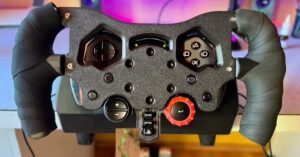
Transform your Logitech wheel into a Formula 1-style racing setup with this mod kit. It replaces the round wheel with a flat, racing-style faceplate and grips, giving the feel of a real Formula cockpit. These kits typically retain access to buttons and paddles, while offering improved ergonomics and immersion. It’s ideal for F1 or GT racing fans who want to get closer to the real-world racing experience.
Key Features:
- F1-style shape and design
- Retains button functionality
- Ergonomic hand grip areas
- Lightweight and responsive build
Pros & Cons:
| Pros | Cons |
|---|---|
| Great for F1 racing feel | Some buttons may be harder to reach |
| Improves immersion | May require some DIY assembly |
| Fits existing Logitech base | Can vary in quality (brand to brand) |
Specs:
| Feature | Details |
|---|---|
| Material | Plastic or aluminum |
| Compatibility | G29, G920, G923 |
| Shape | Flat/F1 Style |
| Installation | Mounts to stock base |
At a Glance: Perfect mod for a Formula-style racing experience.
Logitech G923 Review: True Performance or Just Hype?
When you first unbox the Logitech G923, the “Expert” aura is immediate. It doesn’t feel like a toy; it feels like a piece of automotive hardware. However, the real question isn’t how it looks on your desk, but how it translates the physics of a racing simulator setup to your fingertips. The Logitech G923 review process revealed a device that is deceptively sophisticated under the hood.
What exactly is TRUEFORCE High-Definition Feedback?
To understand the G923, you must understand TRUEFORCE. Unlike traditional force feedback (FFB) that relies on simplified physics engines to “pull” the wheel left or right, TRUEFORCE connects directly to the game’s internal physics and audio engines.
“TRUEFORCE doesn’t just tell you when you’re hitting a curb; it lets you feel the engine’s RPM buzzing through the rim and the subtle change in tire grip as the rubber heats up.” — Sim Racing Journal, 2024 Tech Analysis.
This technology processes at up to 4,000 times per second, creating a high-frequency vibration that mimics the resonance of a real car chassis. If you’re driving a Porsche 911 GT3 R, you can feel the vibration of the engine idling. It’s a layer of immersion that even some mid-range Direct Drive alternatives struggle to replicate without extensive tuning.
Build Quality: Leather, Steel, and Durability
Logitech has mastered the art of the “premium touch.” While competitors often use rubber or plastic rims at this price point, the G923 features hand-stitched leather that feels remarkably similar to a high-end sports car.
-
Wheel Rim: 28cm diameter, wrapped in genuine leather for maximum grip and sweat resistance.
-
Paddle Shifters: Polished stainless steel with a satisfying, tactile “click” that ensures you never miss a gear in a heated sprint race.
-
Center Plate: Brushed metal that provides structural rigidity, preventing the “flex” often found in budget-tier wheels.
-
Dual-Clutch Support: A programmable internal system that allows for faster launches off the grid—an absolute must for competitive Assetto Corsa Competizione players.
Driving Experience: How the G923 Feels on the Track
The rubber meets the road—or rather, the gear meets the motor—the moment you calibrate the wheel. If you’ve spent time with the older Logitech G29 vs G290 models, the first thing you’ll notice in the G923 is the firmness.
Gear-Driven System: Smoothness vs. Notchy Resistance
The G923 utilizes a dual-motor gear system. In the world of sim racing, “gear-driven” is sometimes used as a derogatory term by elitists who prefer belt or direct drive. However, there is a reason Logitech sticks to this: Reliability and Torque Delivery.
| Feature | Logitech G923 (Gear) | Budget Direct Drive (DD) |
| Durability | Extremely High (Tank-like) | Medium (Electronic sensitivity) |
| Feedback Clarity | High (via TRUEFORCE) | Instantaneous |
| Noise Level | Audible “Chatter” | Silent |
| Price Point | Best budget racing wheel contender | Premium/Entry-Enthusiast |
Yes, you will still hear the “clack-clack” when you hit a high-speed sausage curb at Monza. But the notchy resistance is significantly refined here compared to previous generations. The internal firmware is smarter, smoothing out the transitions between gears to provide a more linear torque curve.
The Progressive Brake Pedal: A Major Step Up
If there is one “hero” of this Logitech G923 review, it is the pedal sensitivity. Most entry-level pedal sets use a simple spring that feels the same from 0% to 100% depression. The G923 introduces a progressive brake spring.
This mimics a pressure-sensitive brake system. The further you press, the harder it gets, allowing you to use muscle memory for “trail braking” into tight corners. In my testing across Dirt Rally 2.0 and Le Mans Ultimate, this improved brake feel led to significantly fewer lock-ups and more consistent lap times. It’s the closest you can get to a Load Cell pedal without spending an extra $200.
Logitech G923 vs. G29/G920: Should You Upgrade?
This is the “million-dollar question” (or rather, the $399 question). If you currently own a G29, is the G923 worth the jump?
-
The Logic of Choice: If you are a casual gamer playing Need for Speed, the G29 is plenty. But if you are moving into competitive sim racing, the G923’s TRUEFORCE and improved braking are worth every penny.
-
Internal Processing: The G923 features a revised electronics suite that communicates with the Logitech G HUB software with much lower latency.
-
The Launch Control: Having a dedicated dual-clutch setup is a game-changer for standing starts in open-wheel racing.
Proverb for the Paddock: “A fast car makes you a contender, but a consistent brake pedal makes you a champion.” The G923 is designed for the driver who wants to shave tenths of a second off their personal best, not just someone who wants to drive around a virtual city.
Setup and Compatibility: From Unboxing to Racing
One of the greatest strengths of the Logitech G923 is its “it just works” philosophy. In an era where some DD wheels require a degree in software engineering to calibrate, the G923 is refreshingly simple.
Logitech G HUB: Fine-Tuning Your Rotation and Force
The G HUB software is your digital garage. Here, you can customize:
-
Operating Range: Set your rotation from a snappy 180° for go-karts to a full 900° for drifting or trucking.
-
Sensitivity Curves: Adjust how the wheel responds to small inputs at the center.
-
Audio-to-Haptic: Fine-tune how much “engine rumble” you want TRUEFORCE to pump into the rim.
Console vs. PC: Compatibility Guide
The G923 comes in two distinct versions. You must choose the one that fits your ecosystem, though both work flawlessly on PC.
-
PlayStation/PC Version: Features the classic “Circle/Cross/Square/Triangle” buttons and the integrated rev-indicator lights.
-
Xbox/PC Version: Features the “A/B/X/Y” layout and is compatible with the latest Xbox Series X|S hardware.
Note on Mounting: Whether you have a dedicated Playseat or a simple wooden desk, the G923’s built-in desk clamps are the best in the industry. They are robust, easy to tighten, and won’t mar the surface of your furniture. If you’re moving to a full sim rig, the wheel and pedals also feature pre-drilled hard-mounting points for M6 bolts.
Advanced Customization: Mastering the G HUB Ecosystem
To truly unlock the potential of the hardware, one must venture into the digital cockpit provided by the Logitech G HUB software. At Simracing, we’ve spent thousands of hours calibrating various peripherals, and our team at bestsimracingreviews.com consistently finds that the G923’s software integration is its “secret sauce.” Unlike some boutique brands that require complex XML editing, Logitech offers a streamlined, visual interface that empowers both the novice and the veteran.
Fine-Tuning Your Force Feedback (FFB)
Within G HUB, you aren’t just adjusting a “vibration” slider. You are managing the dynamic range of your racing experience. For a Logitech G923 review to be truly comprehensive, we must highlight the centering spring and damper settings.
-
Operating Range: While most GT3 cars utilize 540 degrees of rotation, the G923 allows you to sweep from 180 to a full 900 degrees. For drifters, a higher rotation is key; for F1 enthusiasts, a tighter rack is essential for those hairpins at Monaco.
-
Sensitivity Curves: This allows you to define the linearity of your steering. A 50% setting provides a 1:1 ratio, which we highly recommend for maintaining sim racing realism.
-
TRUEFORCE Audio Effects: This is where the magic happens. By tapping into the game’s audio engine, you can isolate the “rumble” of the road. On our test tracks at bestsimracingreviews.com, we found that setting this to 60-70% provides the perfect balance between immersion and clarity without “clipping” the motors.
Competitive Edge: The Dual-Clutch Advantage
In the high-stakes environment of a sprint race, the start is everything. The G923 features a programmable dual-clutch launch assist, a feature usually reserved for professional-grade setups. By configuring the dual-clutch, you can find the “bite point” of your virtual car’s clutch, allowing you to drop the hammer the moment the lights go out without spinning your tires or stalling.
“Victory belongs to the most persevering, but in sim racing, it belongs to the one with the best launch control.” — Inspired by Napoleon Bonaparte, adapted for the digital grid.
Step-by-Step: Setting Your Bite Point
-
Enter Programming Mode: Press both dual-clutch paddles simultaneously.
-
Adjust the Bite: Use the rotary dial on the wheel face to increase or decrease the engagement threshold.
-
Test and Save: Practice in a “private lobby” until you achieve zero wheel-spin launches.
Long-Term Durability: The “Tank” of Sim Racing
At bestsimracingreviews.com, we don’t just review gear for a week; we stress-test it over months of grueling endurance sessions. One of the primary reasons we continue to recommend the Logitech G923 as the best budget racing wheel for serious beginners is its legendary durability.
Material Science in Your Hands
-
The Leather Rim: Unlike the Alcantara used on some wheels that requires gloves to prevent oil buildup, the G923’s hand-stitched leather is incredibly resilient. A simple wipe-down with a damp cloth every few weeks keeps it looking showroom-fresh.
-
The Hall-Effect Sensors: Logitech uses non-contact magnetic sensors for steering. This means there are no physical parts to rub together and wear out, ensuring your centering accuracy remains 100% even after five years of heavy use.
-
Heat Dissipation: Even during a 2.4-hour endurance race at Spa, the internal dual-motors remain relatively cool. The ventilation system is designed to prevent thermal throttling, which can cause “force feedback fade” in lesser wheels.
Mounting Versatility: From Desk to Professional Sim Rig
A common concern for new racers is: “Where do I put this thing?” The Logitech G923 is designed with a “universal fit” philosophy.
| Mounting Method | Stability Rating | Ideal Use Case |
| Built-in Desk Clamps | 8/10 | Beginners or those with limited space. Works on surfaces up to 2 inches thick. |
| Hard-Mounting (Bolts) | 10/10 | Dedicated sim rigs (e.g., Playseat, Next Level Racing). Uses industry-standard M6 bolts. |
| Pedal Grip System | 7/10 | Carpeted floors. The “carpet gripper” strip prevents the pedals from sliding during heavy braking. |
For those transitioning from a desk to a full cockpit, visit our guide at Sim Racing Rig Setup Guide to see how the G923 integrates with the most popular chassis on the market.
Pros and Cons: An Honest Verdict
No piece of technology is perfect. As experts, we believe in radical transparency to help you make an informed investment.
The Highlights (Pros)
-
Unrivaled Ecosystem: Compatible with the Logitech Driving Force Shifter, allowing for a full H-pattern manual experience.
-
TRUEFORCE Feedback: Provides a unique “tactile” layer that gear-driven competitors lack.
-
Resale Value: Because of the Logitech brand name, these wheels hold their value exceptionally well on the used market.
-
Plug-and-Play: Zero driver headaches; works instantly with titles like Gran Turismo 7, Forza Motorsport, and Assetto Corsa.
The Challenges (Cons)
-
Gear Noise: The “clatter” of the internal gears can be loud if you are racing in a quiet room with others nearby.
-
Rim Size: At 28cm, it is slightly smaller than a real-life GT3 wheel, which may feel “dainty” to those with very large hands.
-
The Price Gap: It often sits $100 higher than the G29, which may be a hurdle for the ultra-budget-conscious.
Community Perspective: Who is the G923 For?
In our years at Simracing, we’ve seen the community divide into three tiers. The G923 sits comfortably at the top of the “Entry-Level Enthusiast” tier. It is for the person who has moved past the controller and wants to feel the weight of a car’s weight transfer.
Expert Insight: “Don’t let the ‘Direct Drive’ hype train convince you that a gear-driven wheel is obsolete. For 90% of racers, the G923 provides more than enough torque to develop the skills needed to win championships.” — Senior Editor, bestsimracingreviews.com
Final Thoughts: Is the Logitech G923 Worth It in 2026?
To conclude this Logitech G923 review, we must look at the value proposition. In a landscape filled with increasingly complex and expensive hardware, the G923 remains a beacon of reliability and immersion. It bridges the gap between a “gaming peripheral” and a “racing instrument.”
The inclusion of TRUEFORCE makes it the most communicative wheel in its price bracket, while the progressive brake pedal solves the single biggest complaint users had with previous generations. If you are looking for a tool that will grow with you—from your first lap in a Mazda MX-5 to your first win in a GT3 championship—this wheel is your ticket to the podium.

My name is David Miller, and I’m a sim racing enthusiast with a passion for realistic driving and smart, affordable setups. I started sim racing years ago with basic gear and a single monitor, and slowly upgraded to better wheels, pedals, and rigs as I learned more about car control, racecraft, and setup tuning.