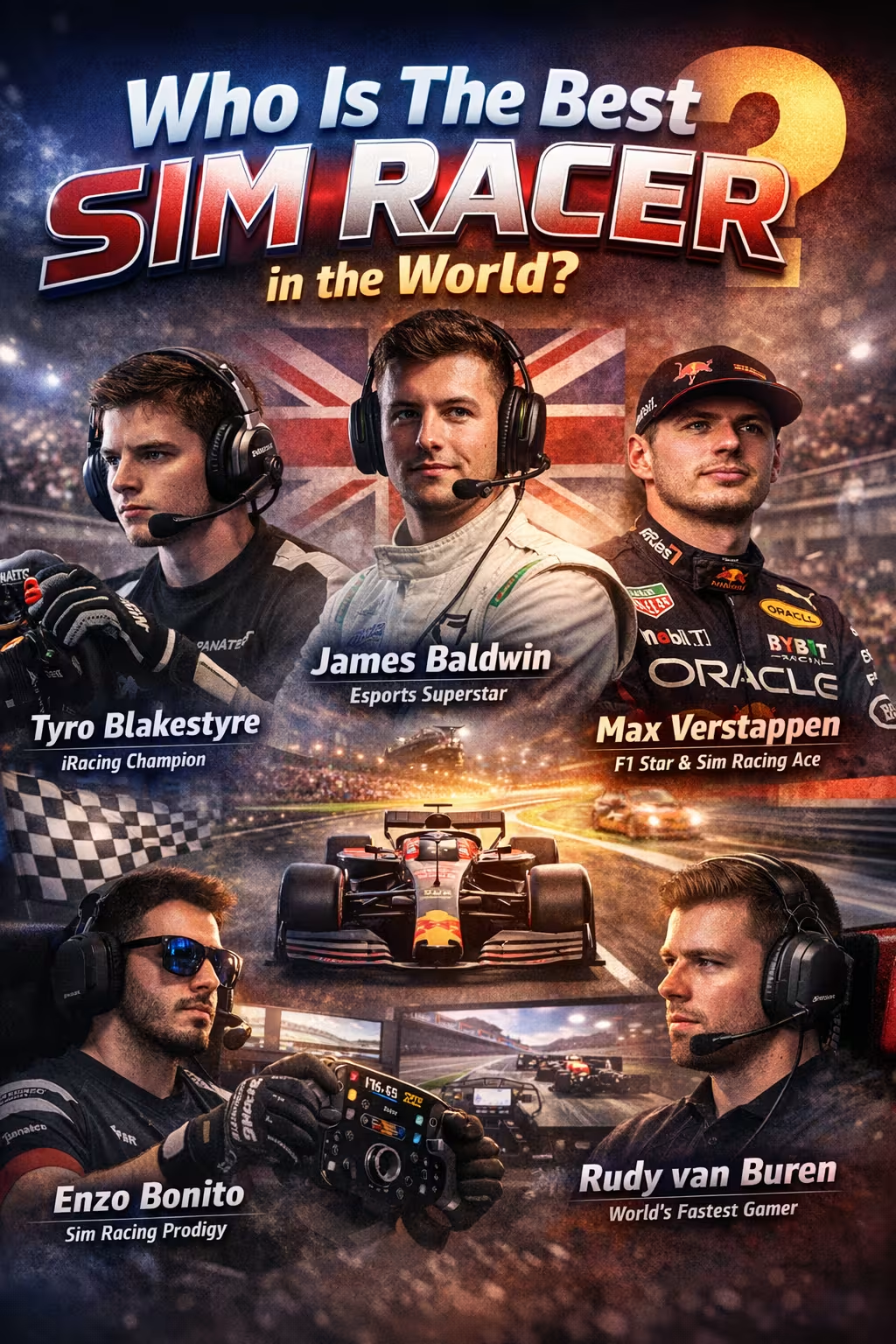
Discover who is the best sim racer in the world with our 2025 deep dive. From Max Verstappen to Jarno Opmeer and Kevin Siggy, we rank the elite drivers dominating iRacing, F1 Sim Racing, and ESL R1. See who takes the #1 spot in the virtual cockpit!
Who Is the Best Sim Racer in the World? 2025 Rankings Revealed!
The smell of burnt rubber might be missing, but the tension in the room is thick enough to cut with a high-end load-cell brake pedal. In the modern era of motorsport, the line between reality and simulation hasn’t just blurred; it has practically vanished.
Today, fans and critics alike are obsessed with a singular, contentious question: Who is the best sim racer in the world? To the uninitiated, it’s a question about video games. To the community of millions who grind on iRacing, Assetto Corsa Competizione, and Rennsport, it is a search for the ultimate digital athlete—a driver capable of finding a thousandth of a second in a vacuum of perfection.
Defining the Best: Who Is the Best Sim Racer in the World Right Now?
When we attempt to identify who is the best sim racer in the world, we must first define the criteria. Unlike traditional sports where a scoreboard tells the story, sim racing is fractured across platforms. However, in 2025, the consensus among professional sim racing rankings points to a few names that have transcended individual titles to reach a state of “virtual godhood.”
To understand the current hierarchy, we have to look at the ESL R1 series, the iRacing World Championship, and the F1 Sim Racing circuit. These are the arenas where the best F1 esports drivers and GT specialists collide.
The Dominance of Jarno Opmeer in F1 Sim Racing
If you measure greatness by silverware and cultural impact, Jarno Opmeer remains the gold standard. As a three-time F1 Sim Racing World Champion, Opmeer possesses a preternatural ability to handle the twitchy, high-downforce requirements of Formula 1 machinery. His move to Oracle Red Bull Sim Racing cemented his status as a titan of the industry.
“In sim racing, you don’t have the ‘seat of the pants’ feel. You have to process visual and auditory data faster than a fighter pilot just to stay on the track, let alone be the fastest.” — Common sentiment among elite drivers.
Kevin Siggy: The King of the Esports World Cup
While Opmeer dominates the open-wheel world, Kevin Siggy has become the face of versatility. Representing Team Redline, Siggy’s victory at the Esports World Cup in Riyadh wasn’t just a win; it was a statement. Dominating the ESL R1 platform—which uses the ultra-realistic Rennsport engine—Siggy proved that he could adapt to new physics models faster than any of his peers. His clinical precision and defensive driving maneuvers make him arguably the most difficult driver to overtake in the world today.
Joshua Rogers: The Most Versatile Speedster in iRacing
No discussion regarding the best sim racer in the world is complete without mentioning the Australian phenom, Joshua Rogers. Within the iRacing ecosystem, Rogers is the benchmark. His dominance in the Porsche TAG Heuer Esports Supercup is the stuff of legend. What sets Rogers apart is his iRating—a numerical representation of skill that remains consistently at the top of the global leaderboards. He doesn’t just win; he redefines the racing line, often finding “exploits” in the physics engine that are actually just displays of extreme mechanical sympathy and technical understanding.
The Verstappen Factor: Is Max Verstappen the Best Sim Racer?
One of the most fascinating narratives in the 2020s is the emergence of a three-time (and counting) F1 World Champion as a legitimate contender for the title of the world’s best virtual racer. Max Verstappen is not a “celebrity guest” in the sim racing world; he is a core fixture.
Team Redline and the Impact of Professional Integration
Verstappen’s involvement with Team Redline, the most prestigious outfit in the industry, has bridged the gap between sim racing and the FIA Formula 1 World Championship. He doesn’t just play for fun; he competes in the 24 Hours of Le Mans Virtual and the iRacing 24h Nürburgring, often pulling “double duty” during real-world Grand Prix weekends.
| Metric | Max Verstappen (Virtual) | Professional Sim Racer (Avg) |
| Platform Consistency | Extreme (iRacing specialist) | High (Multi-platform) |
| Telemetry Analysis | Professional Grade | Professional Grade |
| Hours per week | 20-30 (Season dependent) | 50-70 |
| Race Craft | World-Class (Aggressive) | High (Calculated) |
Analyzing Verstappen’s iRacing Statistics
When you look at Max Verstappen’s sim racing data, the numbers are staggering. He consistently maintains an iRating that puts him in the top 0.01% of all users. His ability to jump from a real RB20 at 200mph to a virtual GT3 car and be within a tenth of a second of specialists like Maximilian Benecke is unprecedented. It raises the question: If Verstappen dedicated 100% of his time to the sim, would he be the undisputed #1? Many experts believe the answer is a resounding “yes.”
The “Grand Slam” Winners: Best Multi-Platform Drivers
True mastery in the digital age is often defined by “cross-pollination.” The best sim racer in the world shouldn’t just be fast in one game; they should be fast in every game. This is where the “Grand Slam” specialists come in—drivers who can swap from a rally car in Dirt Rally 2.0 to a GT3 car in ACC without breaking a sweat.
James Baldwin: From “World’s Fastest Gamer” to Pro GT3
James Baldwin is a living testament to the accuracy of modern simulations. After winning the “World’s Fastest Gamer” competition, he transitioned into real-world GT3 racing with remarkable success. This real-to-sim transition is a key metric in our ranking. Baldwin’s ability to translate “pixel-perfect” laps into “asphalt-tearing” performance proves that his virtual skills are based on fundamental racing physics rather than just “gaming” the system.
Frederik Rasmussen: The Precision Specialist
Often referred to as the “silent assassin,” Frederik Rasmussen is frequently cited by his peers as the fastest man on the planet in terms of raw qualifying pace. He has been the primary rival to Jarno Opmeer for years in the F1 Esports series. Rasmussen’s style is characterized by a lack of visible effort; his inputs are so smooth that the car appears to be on rails. In the high-stakes world of professional sim racing rankings, Rasmussen is the driver everyone fears in a one-lap shootout.
Metrics of Greatness: How We Rank the World’s Best Sim Racers
To provide a truly insightful and informative answer to the question of who is the best, we must look at the data. This isn’t just about who won the last race; it’s about sustained excellence across various metrics.
-
Adaptability: How quickly can a driver master a new physics engine (e.g., moving from iRacing to Le Mans Ultimate)?
-
Race Craft: The ability to manage tires, fuel, and overtakes under extreme mental pressure.
-
Consistency: Maintaining lap times within a 0.05s window over a 60-minute stint.
-
Technical Feedback: Working with engineers to tweak “setups” (damper settings, wing angles, tire pressures).
“Sim racing is 90% mental. In a real car, your body tells you when the tires are slipping. In a sim, you have to see the slip before you feel it. The best in the world have ‘eyes in their hands’.” — Anonymous Pro Driver.
iRating vs. Competition Points: Which Matters More?
In the world of iRacing, your iRating is your badge of honor. It is a dynamic Elo-style system that fluctuates based on who you beat. However, many pros argue that “Championship Points” in sanctioned events like the Porsche Supercup are the truer measure of a driver’s worth. While a high iRating shows you are fast against the public, competition points show you can handle the best sim racers in the world when the lights go out and the pressure is at its peak.
Conclusion: The Future of Virtual Speed
So, who is the best sim racer in the world? While the names on the leaderboard may shift as new software like Assetto Corsa EVO or updated iRacing physics engines debut, the core requirements remain the same: obsession, precision, and an unbreakable mindset. Whether it is Max Verstappen juggling a real F1 career with virtual endurance racing or Kevin Siggy dominating the ESL R1 circuit, these athletes are redefining what it means to be a “driver.”
As the technology improves, the gap between the virtual cockpit and the carbon-fiber tub of a real race car will continue to shrink. For those looking to follow in their footsteps, remember that the journey to becoming the best sim racer in the world starts with a single lap and a relentless pursuit of that next thousandth of a second.

My name is David Miller, and I’m a sim racing enthusiast with a passion for realistic driving and smart, affordable setups. I started sim racing years ago with basic gear and a single monitor, and slowly upgraded to better wheels, pedals, and rigs as I learned more about car control, racecraft, and setup tuning.