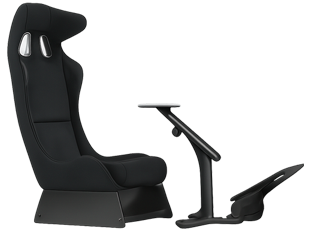

Need help choosing between a Sim Racing Rig vs Wheel Stand? Discover the key differences in stability, immersion, and space to find the perfect setup for your racing needs. Whether you are a casual gamer or a competitive sim racer, our comprehensive guide breaks down the pros and cons to help you decide which equipment fits your lifestyle, budget, and space.
Learn how to elevate your lap times and improve your sim racing ergonomics by picking the right cockpit choice for your unique environment today.
Top Products
1. Anman GT/F1 Sim Racing Cockpit 8040 (Best for Beginners)

Anman GT/F1 Sim Racing Cockpit 8040 Aluminium Profile Racing Stand, Adjustable Cockpit Modular Design Supports DIY Assembly, Fit for Logitech GPRO, for Fanatec CSLDD Direct Drive Steering Wheel
Experience the ultimate in sim racing with the Anman GT/F1 Sim Racing Cockpit. Designed for compatibility with top-tier steering wheels, this adjustable cockpit offers a modular design for personalized assembly and comfort.
Check Price on AmazonKey Features
- Adjustable cockpit for optimal comfort.
- Modular design supports DIY assembly.
- Compatible with Logitech GPRO and Fanatec CSLDD.
- Made from durable 8040 aluminium profile.
- Sleek design enhances any gaming setup.
Pros
- Exceptional Comfort: The adjustable features allow users to find their perfect racing position, enhancing the overall experience.
- High Compatibility: Works seamlessly with popular steering wheels like Logitech GPRO and Fanatec CSLDD, making it versatile for many setups.
- Durable Construction: The 8040 aluminium profile ensures long-lasting use, even under heavy stress during intense races.
- Customizable Setup: The modular design allows for easy modifications, catering to individual preferences and future upgrades.
Cons
- Assembly Required: Some users may find the DIY assembly process challenging or time-consuming.
- Space Consideration: The cockpit may require a larger setup space compared to more compact racing stands.
- Price Point: The cost may be higher than entry-level options, which could deter budget-conscious buyers.
Specs
| 0 | 8040 Aluminium Profile |
|---|---|
| 1 | Logitech GPRO, Fanatec CSLDD |
| 2 | Adjustable and Modular |
| 3 | DIY Required |
| 4 | Lightweight yet sturdy |
At a Glance
2. GTPLAYER Sim Racing Wheel Stand Simulator (Most Saving)
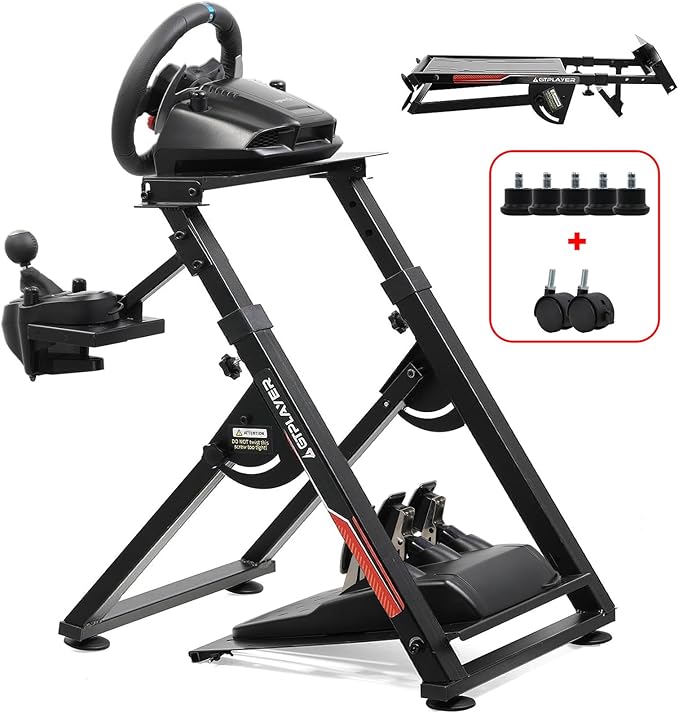
GTPLAYER Sim Racing Wheel Stand Simulator Cockpit Wheel Stand Racing Steering Shifter Mount fit for Logitech G25 G27 G29 G920 G923 Thrustmaster T330TS Gaming Stand Wheel Pedals NOT Included, Black
The GTPLAYER Sim Racing Wheel Stand offers a robust and adjustable platform for racing enthusiasts, compatible with popular Logitech and Thrustmaster wheels. Experience enhanced stability and comfort during your racing sessions with this sleek black cockpit stand.
Check Price on AmazonKey Features
- Compatible with Logitech G25, G27, G29, G920, G923, and Thrustmaster T330TS.
- Adjustable height and angle for personalized comfort.
- Sturdy construction ensures stability during intense racing.
- Easy to assemble and disassemble for convenient storage.
- Lightweight design allows for portability.
Pros
- Enhanced Stability: The robust design minimizes wobbling, providing a solid base for your racing wheel.
- Customizable Setup: With adjustable features, you can tailor the stand to fit your preferred racing position.
- Easy Storage: The stand can be quickly disassembled, making it easy to store when not in use.
- Lightweight and Portable: Its lightweight design allows for easy transport, perfect for taking to racing events or friends' houses.
Cons
- Pedals Not Included: The stand does not come with pedals, requiring a separate purchase for a complete setup.
- Limited Compatibility: While it fits many models, some racing wheels may not be compatible without additional adapters.
- Basic Aesthetic: The design is functional but may lack the premium look of higher-end models.
Specs
| 0 | Logitech G25, G27, G29, G920, G923, Thrustmaster T330TS |
|---|---|
| 1 | High-quality steel |
| 2 | Height and angle |
| 3 | Lightweight design for portability |
| 4 | Easy to assemble and disassemble |
At a Glance
3. Racing Wheel Stand, Height Adjustable & (Best for Most People)

Racing Wheel Stand, Height Adjustable & Foldable Steering Wheal Stand Compatible with Logitech G25,G27,G29,G920 Gaming Cockpit
Elevate your racing experience with the Racing Wheel Stand, designed for compatibility with popular Logitech models. This height-adjustable and foldable stand offers stability and convenience for serious gamers.
Check Price on AmazonKey Features
- Height adjustable for personalized comfort.
- Foldable design for easy storage and portability.
- Compatible with Logitech G25, G27, G29, and G920.
- Sturdy construction ensures durability during intense gaming sessions.
- Easy assembly with no additional tools required.
Pros
- Versatile height options: Adjust the stand to suit your seating position, enhancing comfort during long gaming sessions.
- Compact storage: The foldable design allows for easy transport and storage, perfect for gamers on the go.
- Sturdy build quality: Made from durable materials, this stand provides a solid base for your racing wheel, ensuring stability during intense gameplay.
- User-friendly assembly: Quick and straightforward setup means you can get racing in no time without the hassle of complicated instructions.
Cons
- Limited to specific models: This stand is only compatible with certain Logitech racing wheels, which may limit options for some users.
- Weight considerations: While sturdy, the stand may be heavier than some users expect, making it less portable for frequent movers.
- Basic design: Lacks additional features like built-in storage or advanced adjustability found in higher-end models.
Specs
| 0 | Steel |
|---|---|
| 1 | Yes |
| 2 | Yes |
| 3 | Logitech G25, G27, G29, G920 |
| 4 | Tool-free |
At a Glance
Sim Racing Rig vs Wheel Stand: Key Differences

To understand the difference, you must first understand the purpose. A wheel stand is a portable, often foldable structure designed to hold your steering wheel and pedals. It is the tactical choice for the “living room racer.” A full sim racing rig, on the other hand, is a dedicated cockpit—usually including a seat—that mimics the geometry of a race car.
The following table summarizes the fundamental differences that define these two categories:
| Feature | Wheel Stand | Full Sim Racing Rig |
| Stability | Moderate | Superior |
| Ergonomics | Standard/Adjustable | Fully Configurable |
| Footprint | Compact & Storable | Large & Permanent |
| Best For | Casual/Space-constrained | Competitive/Serious |
| Hardware Limit | Entry to Mid-range Wheels | All Levels (incl. Direct Drive) |
Understanding the Anatomy of a Wheel Stand
A wheel stand is designed with one primary goal: convenience. Most models feature a central or dual-arm pillar that supports the steering base, connected to a pedal deck by a metal spine. This setup is lightweight and often allows the user to fold it up and slide it under a bed or into a closet. It is a fantastic entry point for those using entry-level gear like a Logitech G923 or a Thrustmaster T248.
Understanding the Purpose of a Full Rig
A full rig is an investment in sim racing immersion. It secures your entire body—not just your hands and feet—in a fixed, repeatable position. By bolting your seat, pedals, and wheel to the same rigid frame, you eliminate the “disconnected” feeling of using an office chair. When you reach for that late-braking zone, your seat doesn’t slide backward, and your wheel doesn’t flex, ensuring 100% of your input is transmitted to the game.
The Case for a Sim Racing Rig: Pros & Cons
When you graduate from a wheel stand to a dedicated sim racing rig, you are not merely buying furniture; you are investing in a dedicated cockpit designed to simulate the specific ergonomic geometry of a real race car. At BestSimRacingReviews.com, our extensive testing consistently proves that rigidity is the foundation of competitive sim racing.
As the saying goes, “A chain is only as strong as its weakest link,” and in the world of high-torque direct drive wheels, that link is often a flimsy wheel stand. A full racing rig—typically constructed from tubular steel or modular aluminum profile—anchors your gear, allowing you to maximize the force feedback details coming from your wheelbase. If your mount wobbles, you lose resolution in your steering input, and you lose consistency.
Maximizing Sim Racing Immersion
The primary advantage of a full rig is the complete, unbroken seating position. Unlike a wheel stand, where you must rely on your office chair (which often rolls back under heavy braking), a rig locks your body in place. This creates a consistent muscle memory, which is the holy grail for shaving seconds off your lap times. When you are under heavy braking during a turn at Monza, you need to stomp the pedals with force; a dedicated rig handles this load without compromise.
See more: How to Choose the Perfect Sim Racing Rig: The Ultimate Guide
Compatibility with Direct Drive Bases
If you are running a Direct Drive (DD) wheelbase exceeding 8Nm of torque, a wheel stand will almost certainly introduce “flex.” This movement forces the wheel base to compensate, meaning you are fighting the stand rather than the car. A full rig provides the rock-solid platform required to handle these forces.
“The difference between a wheel stand and a full aluminum profile rig is the difference between playing a game and training for a race. Your brain stops compensating for the wobble and starts focusing on the apex.” — The BestSimRacingReviews Expert Team.
| Feature | Wheel Stand | Full Sim Racing Rig |
| Stability | Moderate | Excellent |
| Ergonomics | Limited | Fully Adjustable |
| Force Feedback | Absorbed (Loss of detail) | Transmitted (High detail) |
| Footprint | Small (Foldable) | Large (Permanent) |
| Price | Affordable | Investment Level |
3 Critical Factors to Guide Your Decision
Making the leap between these two setups requires a logical assessment of your personal circumstances. We have seen too many racers buy an expensive, bulky rig only to realize it doesn’t fit their living space, or conversely, buy a wheel stand that cannot handle the weight of their new top-tier equipment. To ensure you make the right choice, consider these three pillars.
1. Space and Living Situation
This is the “Non-Negotiable” factor. Measure your floor space twice. A wheel stand allows you to tuck your setup into a closet after a session, making it ideal for bedrooms or shared living areas. A full rig, especially an aluminum profile one, is a statement piece. It demands a dedicated corner or room. If you are living in a compact apartment, don’t let the “immersion” factor blind you to the reality of the floor space you have. If you cannot leave the rig set up permanently, a heavy-duty foldable rig (a hybrid between the two) might be your best middle ground.
2. Your Budget and Long-term Goals
Think in terms of “Total Cost of Ownership.” If you buy a cheap wheel stand now only to replace it with a rig six months later, you have essentially wasted the cost of the stand. However, if you are unsure if sim racing will be a permanent hobby, starting with a quality, entry-level wheel stand is a smart financial move. As we often advise at BestSimRacingReviews.com, “Buy once, cry once.” If you are certain about your passion, save for the rig. If you are testing the waters, the stand is your gateway.
3. Your Chosen Hardware (Wheel & Pedals)
This is the technical limit. Match the support to the strength of your peripherals:
-
Entry-level Wheels (e.g., Logitech G29, Thrustmaster T150): These are perfectly suited for wheel stands. The torque is low, and the weight is manageable.
-
Mid-range to High-end (e.g., Fanatec CSL DD, Simucube, Asetek): These require the rigidity of a full cockpit. Using a high-end DD wheel on a budget stand is like putting racing slicks on a lawnmower; you will never utilize the full performance because the mount will buckle under the pressure.
Can You Upgrade? The Path from Stand to Rig
You do not have to make the final decision today. The modern sim racing market is built on modularity. Many manufacturers offer a “Wheel Stand” that serves as the base chassis, to which you can later purchase a “Seat Add-on” or “Rear Section.” This is a fantastic strategy for those who want to enter the hobby without a massive upfront cost but plan to expand later.
-
Modular Start: Purchase a stand compatible with an upgrade path.
-
Expansion: Buy the seat frame when you have the space and funds.
-
Customization: Look for brands that use standard T-slot aluminum profiles; these can be modified, drilled, and added onto indefinitely.
If you find yourself glued to the track for hours every weekend, you will eventually outgrow the stand. Knowing that your initial investment is modular can provide peace of mind. Check our detailed component guides at BestSimRacingReviews.com for specific models that offer this “upgradeable” architecture.
Conclusion: Choosing the Right Setup for You
Ultimately, the battle of “Sim Racing Rig vs Wheel Stand” has no single winner—it has a winner for you. If you are a casual racer, a university student, or someone who values the ability to reclaim their floor space, a high-quality wheel stand is a brilliant tool that will bring joy to your racing experience without cluttering your home. However, if you are chasing tenths of a second, investing in a high-torque Direct Drive system, and have the dedicated space, a full sim racing rig is the only path forward. It transforms your gaming session into a professional training environment.

My name is David Miller, and I’m a sim racing enthusiast with a passion for realistic driving and smart, affordable setups. I started sim racing years ago with basic gear and a single monitor, and slowly upgraded to better wheels, pedals, and rigs as I learned more about car control, racecraft, and setup tuning.