
Introduction
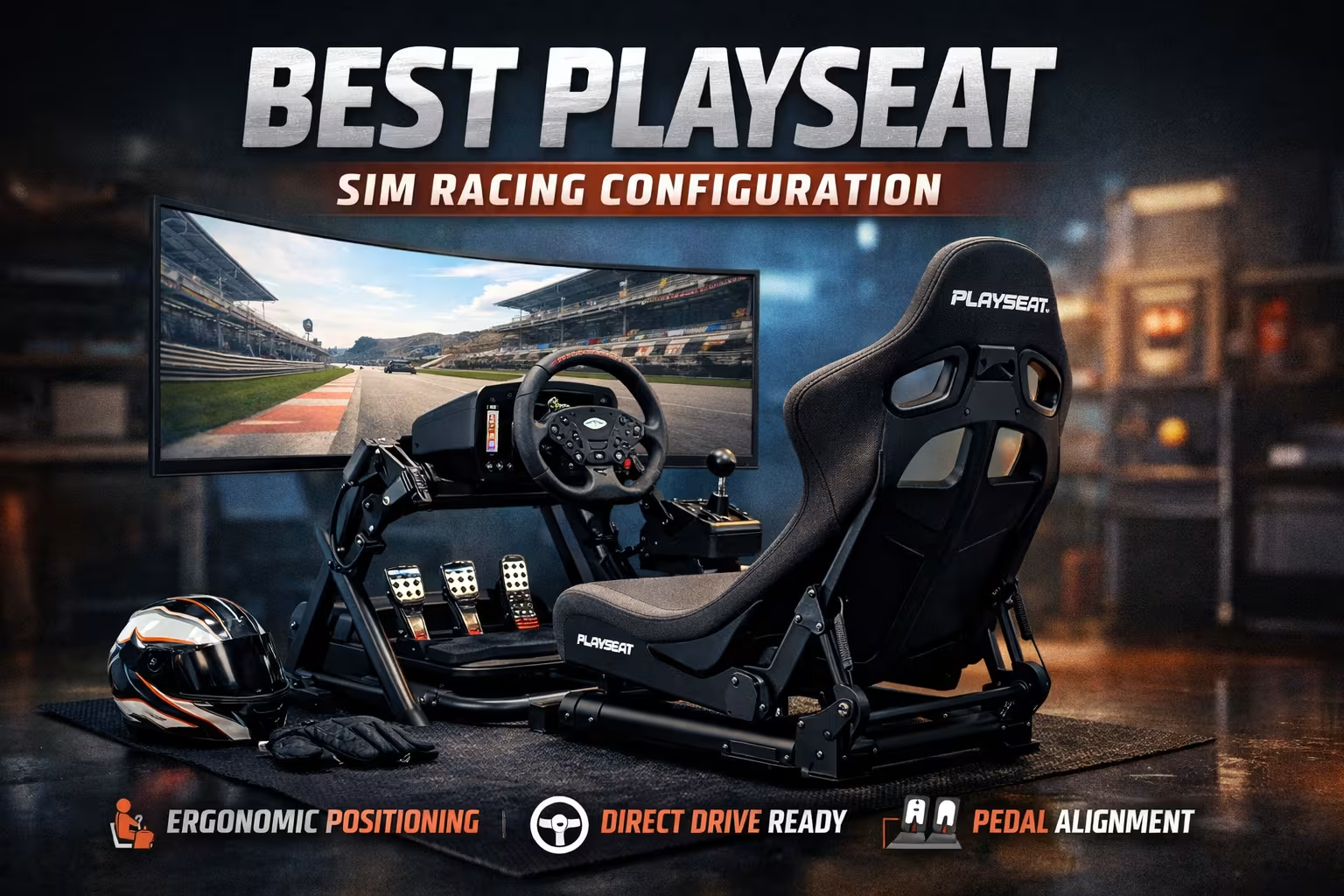
A Playseat rig can feel “okay” out of the box—or it can feel like a proper cockpit that helps you drive smoother, brake harder, and stay consistent for longer sessions. The difference is rarely the seat alone. It’s the configuration: how you position the seat, wheel, pedals, monitor, and accessories so your body is stable and your inputs are repeatable.
This guide rewrites the original “tested by our team” format into a clearer, more practical setup playbook: quick recommendations first, then product-style breakdowns, then a configuration checklist you can follow in 30–60 minutes.
Top Picks (Quick Recommendations)
If you want a fast decision path, think in three tiers:
-
Small space / foldable setup: Playseat Challenge / Challenge X
-
High-performance / direct drive friendly: Playseat Trophy
-
Budget hybrid (desk + wheel stand): A solid wheel stand if you can’t dedicate a full rig
The original article’s “top products” list is essentially built around those scenarios, plus add-ons like a floor mat and seat slider for shared setups.
Product-Style Breakdown (What Each Option Is Best For)
1) Wheel Stand (Budget + Space-Friendly)
Best for: desk racers who want better stability than clamping to a table
A wheel stand is the “minimum effective upgrade.” You get improved rigidity and better pedal placement without committing to a full cockpit. The trade-off is seat movement: if your chair rolls, your braking consistency drops.
Configuration tip: if you go wheel stand, prioritize (1) locking chair wheels or a wheel stopper, and (2) a floor mat for grip.
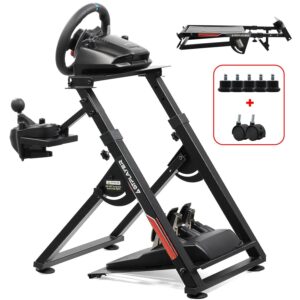
GTPLAYER Sim Racing Wheel Stand Simulator Cockpit Wheel Stand Racing Steering Shifter Mount
GTPLAYER Sim Racing Wheel Stand Simulator Cockpit Wheel Stand Racing Steering Shifter Mount fit for Logitech G25 G27 G29 G920 G923 Thrustmaster T330TS Gaming Stand Wheel Pedals NOT Included, Black
2) Playseat Challenge X (Foldable, Daily-Use Friendly)
Best for: small rooms, shared living spaces, or anyone who must pack the rig away
The Challenge X concept is straightforward: foldable frame, adjustable seating geometry, and adjustable wheel/pedal mounts. On the official product description, the wheel and pedal mounts are designed to be adjustable for distance/angle/height, and the seat posture has multiple reclining positions.
Configuration tip: spend your time on pedal distance + seat recline first. Once your legs feel natural under braking, your wheel height/tilt becomes easier to finalize.
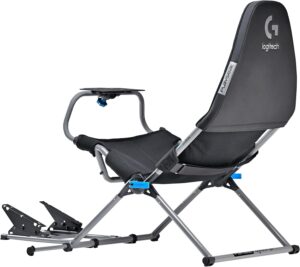
Playseat Challenge X – Logitech G Edition Sim Racing Cockpit
This lightweight, foldable racing seat delivers a realistic driving feel with six X-Adapt seating positions, letting you fine-tune pedal and wheel placement for car-like ergonomics. Breathable ActiFit material keeps you cool and comfortable during long sessions, while adjustable rigidity provides strong, body-conforming support. At just 11.5 kg (25 lbs), it stores easily in small spaces.
3) Playseat Trophy (Performance Choice, Direct-Drive Capable)
Best for: serious sim racers who care about rigidity, comfort, and upgrade headroom
The Trophy line is designed as a lightweight but rigid frame and is positioned for high-performance use. Playseat’s official FAQ lists key physical specs (including overall dimensions and weight) and recommended user ranges, which is useful when you’re choosing for shared use at home.
Configuration tip: treat this like a “set it and forget it” cockpit. Get your measurements right once, then mark bolt positions (or take photos) so you can return to your baseline quickly after any changes.
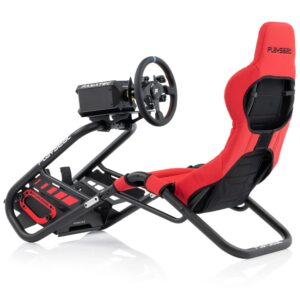
Playseat Trophy Sim Racing Cockpit
Playseat Trophy is a compact, sturdy, high-performance sim racing cockpit with a lightweight, frameless design developed with pro drivers and esports athletes. The breathable ActiFit microfiber seat helps reduce heat and sweat for better focus. A fully adjustable bucket seat fits many body sizes, and it supports direct-drive wheels on PC and consoles.
4) Playseat Evolution / Evolution Pro (Classic Full Cockpit)
Best for: a traditional “wheel + pedal + seat in one frame” feel
These models sit in the middle: more dedicated than a wheel stand, often more flexible in home layouts than bulkier aluminum profile rigs. The configuration challenge tends to be alignment: you want the wheel centered to your body and the pedals square to your hips.
Configuration tip: if multiple people use it, a seat slider is a high-value add-on because it reduces the temptation to “half-adjust” and drive in a compromised posture.
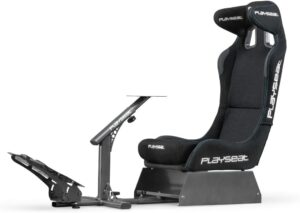
Playseat Trophy Sim Racing Cockpit
Playseat Trophy Sim Racing Cockpit | High Performance Racing Simulator Cockpit | Supports Direct Drive | Compatible with All Steering Wheels & Pedals on The Market | Supports PC & Console | Red
5) Add-ons That Actually Matter
Floor mat: protects flooring and improves grip so the rig doesn’t creep forward under braking.
Seat slider: speeds up switching between drivers and makes repeatable positioning easier.
The Configuration That Works (A Practical Setup Checklist)
Step 1: Lock your seat position first
-
Aim for a posture where your hips are stable and your lower back is supported.
-
You should not be “reaching” for the wheel or pedals.
For foldable rigs, posture/recline choices are a core feature (multiple positions are part of the design intent), so start there.
Step 2: Set pedal distance for braking control
A reliable baseline:
-
With your foot on the brake at maximum pressure, your knee remains slightly bent (not locked).
-
Your heel can stay planted (or at least consistent) so you’re not “chasing” the pedal.
On adjustable rigs like the Playseat Challenge family, pedal plate distance and angle are expected adjustment points—use them.
Step 3: Align wheel height and reach
-
Your shoulders should stay down (no shrugging).
-
Elbows should be comfortably bent when holding the wheel at a natural position (many drivers use a “9 and 3” style grip).
If you feel upper back fatigue, you’re often too far from the wheel or the wheel is too high.
Step 4: Wheel angle (tilt) for wrist comfort
-
Too flat = wrist strain and poor leverage on corrections
-
Too steep = shoulder fatigue
Set tilt so your wrists stay neutral while turning through medium corners.
Step 5: Shifter/handbrake placement (if applicable)
-
Place it where your arm can move without twisting your torso.
-
Your elbow should travel, but your shoulder should not need to rotate aggressively.
Step 6: Monitor positioning (the “free lap time” upgrade)
Even without changing hardware, a better screen position improves consistency:
-
Center the monitor to your wheel.
-
Place it as close as practical without causing eye strain.
-
Adjust height so you’re not looking up/down significantly during racing.
Step 7: Eliminate flex and movement
-
Tighten bolts in a logical sequence (frame first, then mounts).
-
If your rig shifts under heavy braking, solve grip first: mat, wheel stoppers, or anchoring.
Step 8: Cable management for reliability
The goal is not aesthetics—it’s repeatability:
-
Make sure nothing pulls when you turn lock-to-lock.
-
Ensure USB/power lines don’t snag during folding (for Challenge-style rigs).
Step 9: Run a 10-minute calibration drive
Do one short session:
-
3 laps warm-up
-
3 laps pushing
-
3 laps focusing only on braking consistency
If your braking is inconsistent, revisit pedal distance and seat stability before changing anything else.
Step 10: Freeze your “baseline”
Once it feels right:
-
Take photos of clamp points, bolt positions, seat recline settings
-
Mark key positions with small tape markers
This prevents endless tweaking.
Buying Guide (What Matters Most)
Comfort and ergonomics
If you race longer than 30–60 minutes, comfort becomes performance. Prioritize adjustability where your body needs it: seat posture, pedal reach, wheel height/tilt.
Compatibility
Most Playseat-style setups are built around mainstream wheel/pedal ecosystems, but you should still confirm fitment—especially if you plan direct drive or heavy load-cell braking.
Build quality and stability
Rigidity affects:
-
braking consistency
-
steering precision
-
fatigue
For Trophy-style performance rigs, Playseat positions the platform as a more “serious” solution with defined physical specs and user ranges (helpful for sizing).
Space and portability
If you need to fold and store, choose a design intended for that workflow—Challenge X is explicitly presented as adjustable and posture-flexible for a wide range of setups.
Price and value
Pay for the thing you can’t fix later:
-
You can upgrade pedals/wheel over time.
-
A poor-fitting cockpit tends to remain poor-fitting.
Conclusion
A “best Playseat sim racing configuration” is not a single magic measurement. It’s a repeatable workflow: lock posture, dial pedal reach, align the wheel, reduce movement, then preserve your baseline. If you need portability, focus on a foldable cockpit configuration approach (Challenge/Challenge X). If you want performance headroom—especially for stronger hardware—Trophy-style rigs are built and spec’d for that higher-demand use case.

My name is David Miller, and I’m a sim racing enthusiast with a passion for realistic driving and smart, affordable setups. I started sim racing years ago with basic gear and a single monitor, and slowly upgraded to better wheels, pedals, and rigs as I learned more about car control, racecraft, and setup tuning.